Every partnerships budget conversation has the same shape. The partner lead asks for headcount and tooling. The CFO asks what the return will be. And the honest answer, in most companies, is a well-intentioned guess.
That guess is why partnerships is the first line cut in a hard budget round. Not because ecosystems fail to produce revenue, but because the ask arrives without the evidence every other function is held to. Sales brings pipeline coverage. Marketing brings CAC by channel. Partnerships brings a slide of logos and a feeling.
A CFO hears three questions inside every partnerships ask. Here is the difference between the traditional answer and the measured one.
What is the expected return?
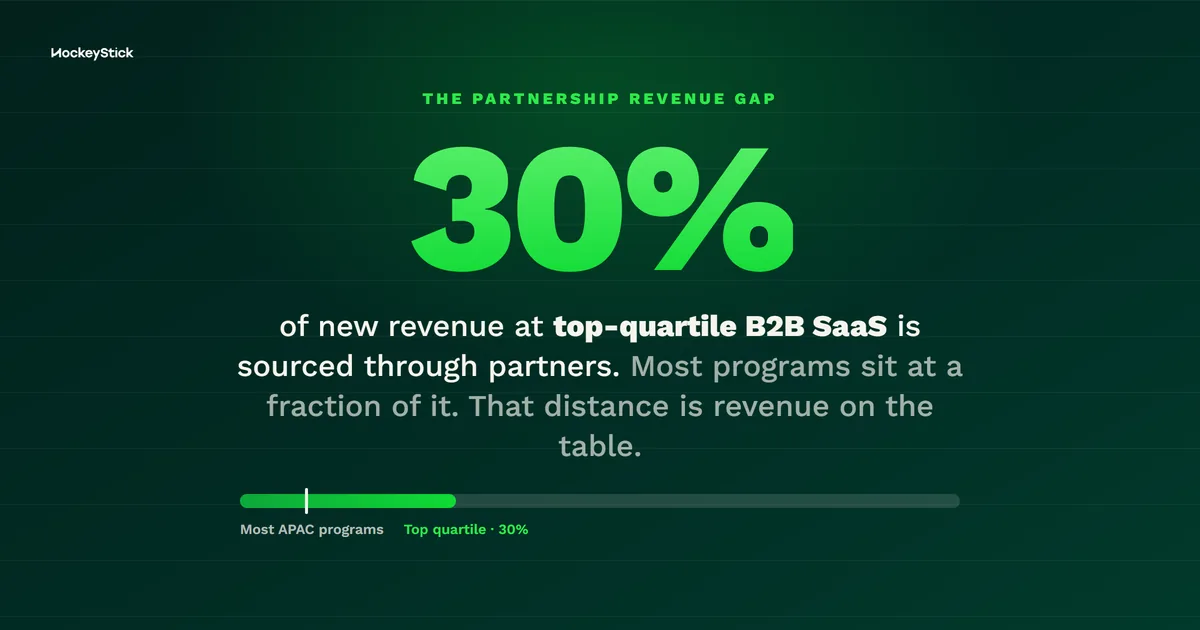
Traditionally: an estimate built from industry anecdotes and a slide about ecosystem-led growth. Measured: cost per lead and customer acquisition cost for partner-sourced deals, tracked in the CRM against benchmarks. Across the client engagements we measure, partnership CAC runs well below blended paid acquisition, and top-quartile B2B SaaS companies source around 30 percent of new revenue through partners. Put your own number against that and the return is a range, not a hope.
Is partnership more efficient than paid channels?
Traditionally: probably, anecdotally, everyone agrees warm intros close better. Measured: a direct CAC comparison in the CRM, dollar for dollar, using attribution rules written down before the quarter started. Sourced means the partner opened the door. Influenced means the partner materially moved a deal someone else opened. Blur the two and the CFO will discount both; keep them separate and the efficiency argument holds.
What is the payback period?
Traditionally: unknown, because nobody instrumented the motion when it started. Measured: interim signals at ninety days (partner-registered opportunities, co-sell meetings held, first-touch pipeline), confirmed at one hundred and eighty days by closed revenue and the slope of the line. Boards fund slopes. A flat line with a good story gets cut; a line moving from 6 to 9 to 12 percent gets doubled down on.
The pattern across all three: the traditional answers are hopes, and the measured answers are records. The gap between them is why partnership budgets get cut first, and why the operators who measure are pulling away from the ones who narrate.
What should a CFO ask before funding partnerships?
Three things. What is partner-sourced and partner-influenced revenue today, measured with rules you can show me. What is the benchmark for a company like ours. What is the plan to move from one to the other, quarter by quarter. A partner lead who can answer all three is asking for an investment. One who cannot is asking for a favour.
How do you compare partnership CAC to paid?
Same denominator, same window. Fully loaded partner program cost (people, tooling, partner incentives, events) divided by partner-sourced customers, against fully loaded paid spend divided by paid-sourced customers, over the same period. Most companies that run the comparison honestly find the partner number is a fraction of paid. Almost none had run it before.
What interim signals prove a partner motion is working?
Before revenue: partner-registered opportunities rising month on month, co-sell meetings actually happening, partner mentions appearing in deal notes, and time-to-first-meeting shrinking on partner-sourced accounts. After revenue: win rate and deal size on partner-influenced deals against the rest of the pipeline. If the leading indicators are flat at ninety days, the design is wrong, not the channel.
Your starting point is one number: what the ecosystem should be returning. The Revenue Gap Calculator produces it in five minutes. Then bring it to Accelerate on 28 October at Marvel Stadium, where the day opens with the room's own benchmarks and the operators who built them.
Register for Accelerate, 28 October, Marvel Stadium.