Most B2B companies can quote their pipeline to the dollar and their CAC to the cent, then go completely quiet when asked one question: how much revenue should your partner ecosystem be producing?
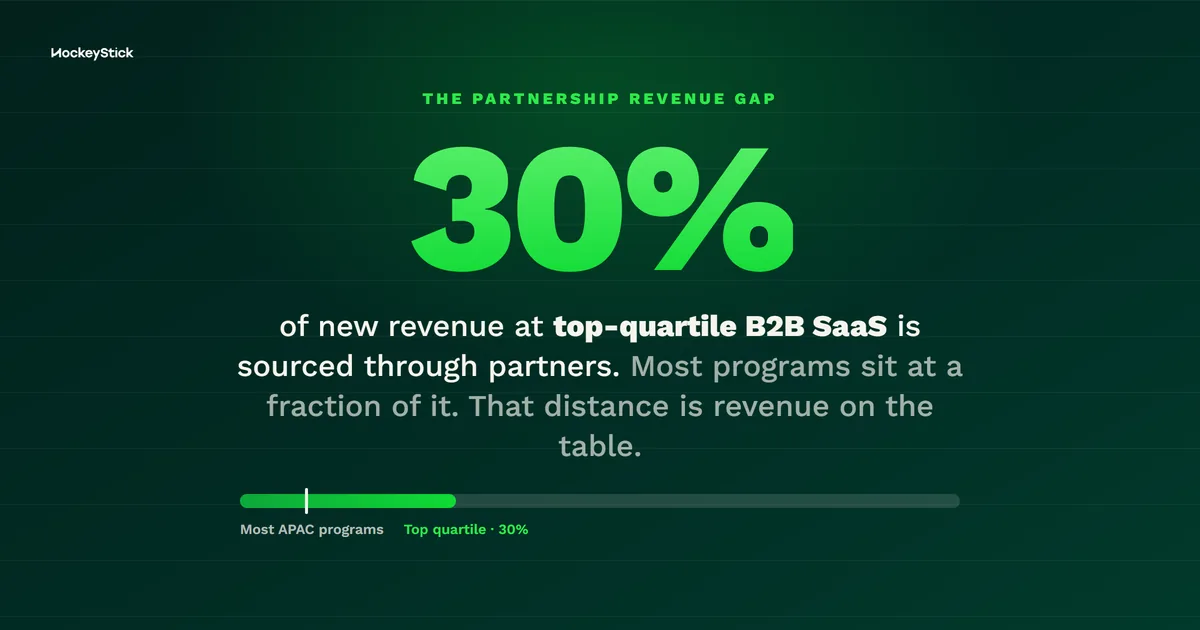
Not "is it producing something". Almost every ecosystem produces something. The question is the gap between what it produces and what a structurally similar company with a working partner motion gets from the same assets. In top performing B2B SaaS companies, partner-sourced revenue sits around 30% of new business. For most of the companies we assess across APAC, the real number is a fraction of that, and nobody inside the building can say what the miss is worth.
That number has a name: the partnership revenue gap. And it behaves less like a marketing metric and more like a balance-sheet item. It compounds. Every quarter a partner program runs on goodwill and ad hoc intros instead of process, the gap between you and the operators who systematised their motion widens, because ecosystems reward accumulated trust and repeatable execution, not bursts of effort.
Three patterns show up in nearly every gap we measure.
First, partnerships report activity, not revenue. Partner counts, MOUs signed, logos on a slide. None of it is cash, and when the CFO asks what the program returned, the honest answer is a shrug. If the partner motion cannot be expressed in sourced and influenced revenue, it will always be the first budget cut and the last hire approved.
Second, the motion is staffed before it is designed. A partner manager gets hired into a company with no ICP overlap mapping, no co-sell process and no executive sponsor, then gets performance-managed for failing to overcome all three. Structure precedes headcount in every ecosystem that works.
Third, nobody owns the number. Sales owns quota, marketing owns pipeline, and partner revenue floats between them, claimed by both when it lands and owned by neither when it does not.
The fix starts with measurement, which is why we built the Revenue Gap Calculator: five minutes, your revenue profile against benchmark data from across the region, and a dollar figure for what the ecosystem should be returning. From there, maturity and readiness diagnostics tell you whether the gap is a strategy problem, a structure problem or an execution problem.