To get your CFO to fund partnerships, stop pitching finance and build the plan with them. That is Rob Moyer's answer. Rob is the founder of BlueThread, a Partner RevOps advisory for B2B SaaS companies, and the former Global Head of Partnerships at Gong. His method: find an ally in FP&A, prove partner win rates and deal size against direct, and make sales co-own the partner number. A plan finance helped write is a plan finance will defend.
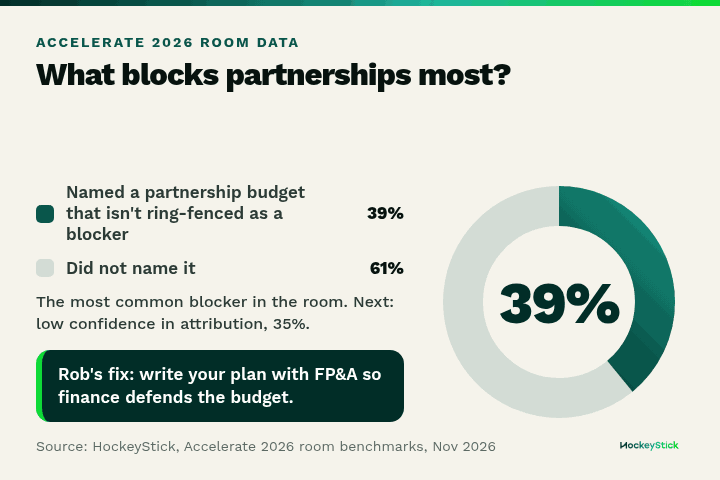
It matters because the partnerships budget is usually the first line questioned. At Accelerate 2026, 39% of the room named a partnership budget that isn't ring-fenced as a blocker, the most common answer on the day.
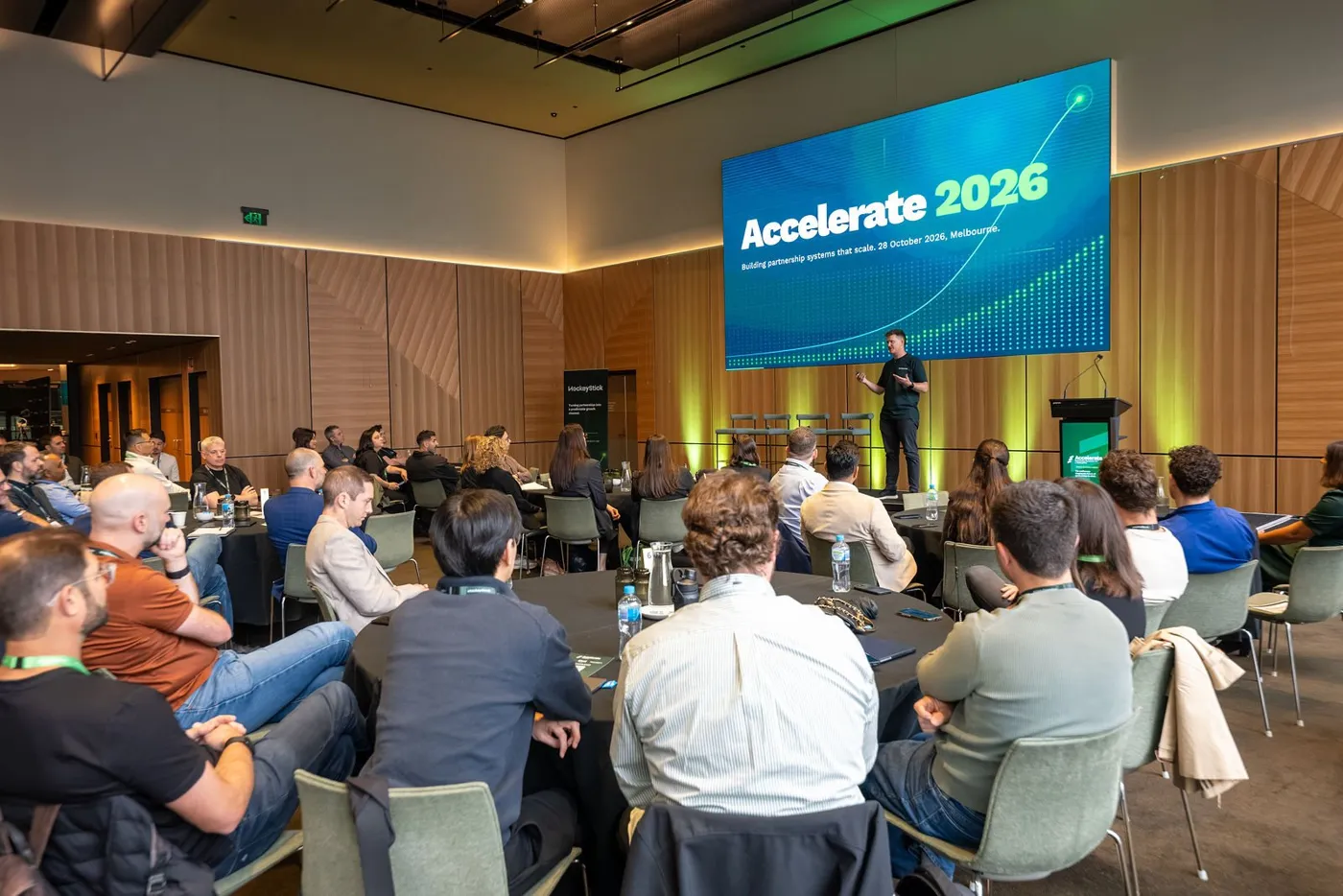
I interviewed Rob on stage at Accelerate 2026 in Melbourne on Wednesday 28 October. We agreed on the method but not on the starting point, and that disagreement is where most teams get stuck. Below is Rob's playbook, where we differ, and a toolkit for this week: an FP&A meeting agenda, the exact comparison to pull and a pod template.
Should you demand a partnerships budget or earn it first?
Rob says ask for it up front. I say most teams have to earn it. We both think the answer is a plan finance trusts. We differ on what you do before the money arrives.
Rob's position is firm. In the final interview for any role, he asks "what's the budget?" If the company is on the fence, he tells them he feels strongly that he has to have one.
My view on the day was more cautious: "Everyone wants budget, but you're probably not gonna get what you want. So you're able to do a lot more yourself." Most teams I work with have to show partner revenue before the budget follows.
Where we land (HSA's interpretation): ask for the budget, but take two versions of the plan to finance. The full plan shows what the budget buys. The self-funded plan runs on what you already have: your CRM, Slack or Teams, and one partner type. It also names the result that unlocks the full budget, such as a partner win rate above direct for two quarters in a row.
Why do partnership budgets get cut first?
Because leaders expect partner revenue faster than they protect the budget that produces it. We measured the room on the day, with 89 readiness assessments completed live and 86 people answering live polls.
- 62% said executives expect partner revenue within six months.
- 39% named a budget that isn't ring-fenced as a blocker, ahead of low confidence in attribution at 35%.
- Data and budget were the weakest readiness pillars, both averaging 57%.
A short payback expectation, an unprotected budget and numbers finance doesn't trust: that combination is why the partnerships line goes first.
How do you get finance on side before the CRO sees the plan?
Make a friend in FP&A and have them help write the plan. Rob said a mentor told him early to make friends with FP&A. Since then, he asks who in FP&A will help him write his plan before he takes a role.
The reason is trust. Finance teams, in Rob's words, "hate partner influence," so a plan they didn't help build starts under suspicion. In two of his last few jobs, he said, finance built out his cost of sale and his partner win rates. By the time he presented to the CRO, "finance was already loving it."
“By the time that plan gets there, you're halfway there.”
Rob Moyer, founder, BlueThread
Rob's test for the whole approach: if you make your CFO or CRO "look good when you're not in the room, you're going to get what you want."

Which numbers should a partnerships plan show finance?
Lead with win rate, then average deal size, on top of clear attribution. Rob starts by splitting attribution into three tiers: partner sourced, co-sell and influenced. Keep them separate, because influence is the number finance trusts least. At Accelerate 2026, 43% of the room rated their confidence in partner attribution at 2 out of 5 or lower.
Win rate changes the pipeline maths. Finance usually hands you a target built on the direct team's assumptions, such as 5x pipeline coverage. Rob said he has never seen a company where partner win rates weren't better than direct, so you can hit the same number with less pipeline. With illustrative numbers: on a $2 million target, a 20% direct win rate needs $10 million of pipeline. At a 30% partner win rate, the same target needs about $6.7 million.
Deal size is the second story. For technology partners, integrations tend to bring higher win rates, larger deals, lower churn and more multi-year contracts. As Rob put it, "those are stats that product knows, but the revenue side doesn't."
Then add the long view. Rob argued "there's very few companies that ever made it to a billion dollars without partners." Before one annual operating plan, he had finance break down what share of revenue came from partners at each growth stage for other software companies. He walked in with a three-year story: where we are, where we're going and what next year's number needs.
“You got to tell a good story and it's got to be factual.”
Rob Moyer, founder, BlueThread
On stage, I added the one-page version: build the case around a single halo stat, such as how much faster partner-involved deals close in your own CRM.
Why split the plan by partner type?
Because one motion spread across every partner type fails, and finance can't fund what it can't see. Rob described his early team, where everyone covered three types of partner. "We blew up our first motion because we were just spreading," he said.
His fix was a separate play for each lane, such as private equity, agencies and hyperscalers. He even split the partner tech budget by each segment's share of the business. In his words, an operator model "means maniacal focus on your partner type and their experience and where they fit in the sales cycle."
For a CFO, that turns one vague line item into a few small bets that can each be tested.
How do you make sales co-own the partner number?
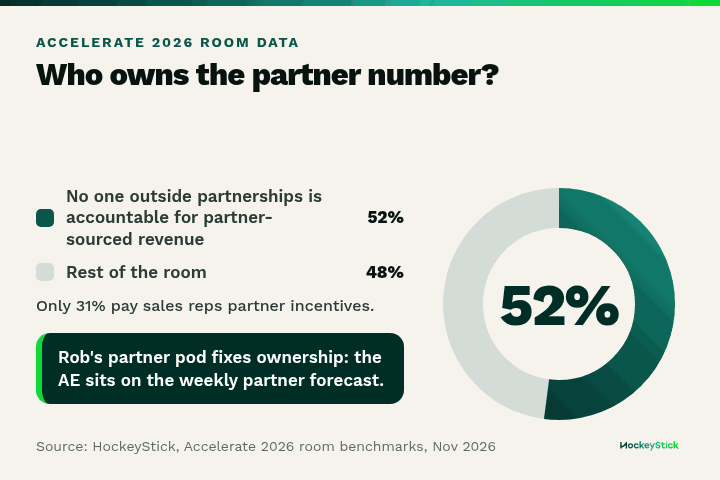
Run a weekly partner pod. When Rob advises a company, he asks: "do you have a weekly forecasting and who's in it?" His pod brings together marketing to drive leads, the account executive who works with the partner, and the partner manager as orchestrator. It runs like a forecast call. Instead of calling the close, the pod calls the conversions: lead to sales accepted to SQL.
The AE is the piece most teams miss. Rob's view is that real co-sell needs an AE who accepts and works the partner lead. "So my pod is very simple. It's bringing the right people to impact the deal and have maniacal focus." BlueThread's published field note reports that its client Arcoro cut more than 50 channel partners to six, put each AE and partner on the same weekly forecast meeting, and grew partner-sourced share of pipeline about 2.5 times in 2026.
Most rooms aren't set up this way. At Accelerate 2026, 52% said no one outside partnerships is accountable for partner-sourced revenue. Only 31% pay sales reps partner incentives, and 28% have no partner forecast at all.
Rob's advice is to give a new pod at least two months before you judge it. If it stalls, check you picked the right partners and the right AE.

Frequently asked questions
What if we don't have enough partner deals for a reliable win rate?
Our view: pool the last four quarters and include co-sell deals. If you still have only a handful of closed deals, present the comparison as directional and agree with FP&A the sample size that would make it firm. Saying so up front builds more trust than an overstated number.
Do I need a PRM to build this case?
No. Rob argues partner tech is going headless, with the work moving into the CRM, Slack and Teams. At Accelerate 2026, 69% of the room ran partner activity in the CRM alone, with no PRM.
Want a second view on your plan?
If you're taking a partnerships plan to finance this quarter, talk to Hockey Stick Advisory. We'll pressure-test the numbers before your CFO does.